How to Change Your Visa After Graduation
Many international students in Korea start looking for full-time employment before or after graduation.
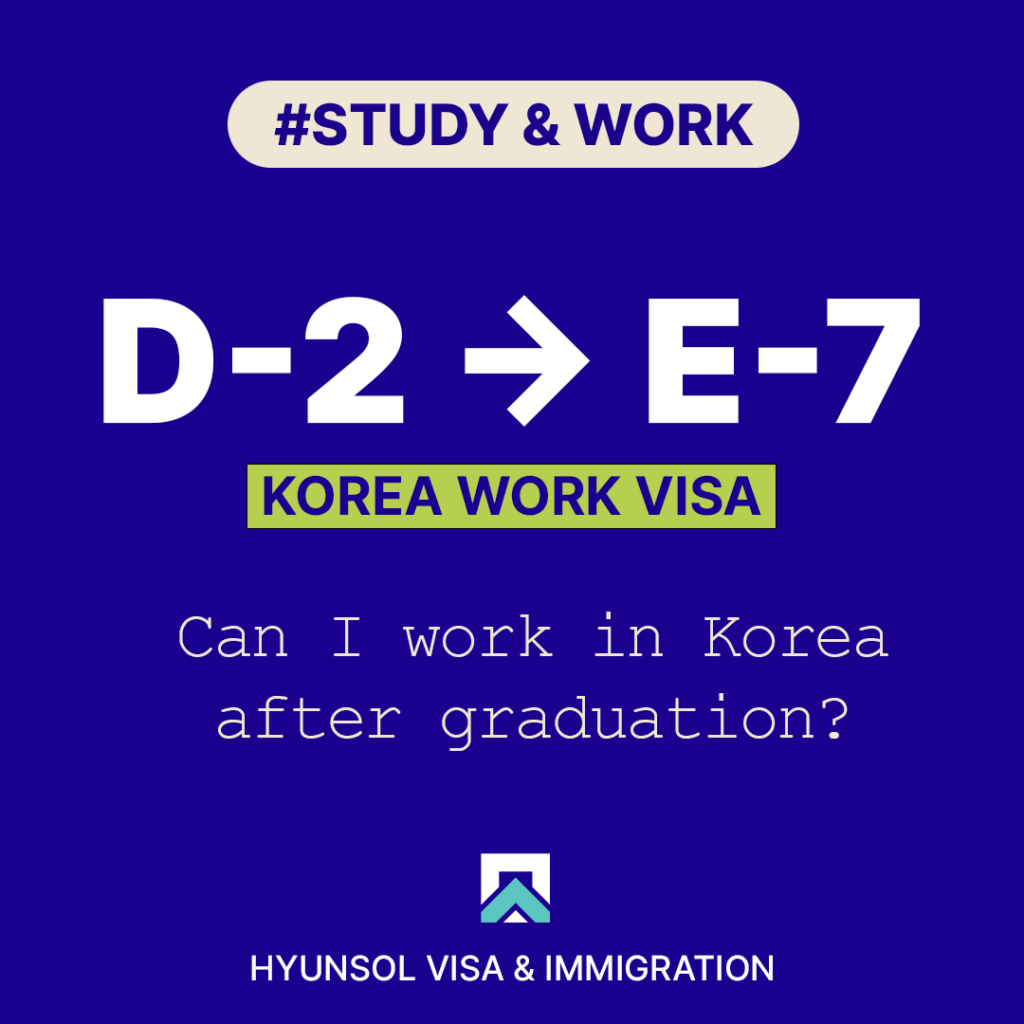
If you receive a job offer from a Korean company while staying in Korea on a D-2 visa, one of the first things you need to consider is whether you can change your status of stay to an E-7 visa.
Getting a job offer does not automatically mean that you can start working immediately. Your academic background, the position offered, the employer, salary, and other requirements must meet the applicable immigration rules.
This article explains the main points to consider when changing from a D-2 student visa to an E-7 work visa in Korea.
Can You Change from a D-2 Visa to an E-7 Visa?
A D-2 visa is a status of stay for studying in Korea. If you plan to work full-time after graduation, you need a status of stay that permits the type of employment you will perform.
International students who are graduating or expected to graduate may apply for a change to an employment status, including E-7, if they meet the requirements for the relevant employment category.
For an E-7 visa, simply having a university degree and an employment contract is not enough. The specific occupation must fall within an eligible E-7 category, and the applicant and employer must meet the applicable requirements.
Does Your Major Need to Match Your Job?
Your degree and the position offered by the company are important when preparing an E-7 application.
For graduates of Korean universities, immigration rules provide certain exemptions from career requirements. However, the applicable standard may differ depending on the level of degree and the specific E-7 occupation.
For example, graduates with an associate degree from a Korean university may change to E-7 without meeting separate career requirements when the employment field is related to their major. Similar exemptions may apply to holders of a bachelor’s degree or higher from a Korean university, subject to the requirements of the relevant E-7 occupation.
Therefore, it is important to identify the exact E-7 occupation first and then determine which education, major, career, or qualification requirements apply.
The Employer Must Also Meet E-7 Requirements
An E-7 application is not reviewed only based on the foreign employee.
The company hiring the applicant may also be subject to requirements concerning its business, number of Korean employees, proportion of foreign employees, and the necessity of hiring a foreign worker.
The employment contract must also satisfy the salary requirements applicable to the relevant E-7 category.
For this reason, it is useful to review both the applicant’s qualifications and the employer’s conditions before preparing the application.
When Can You Start Working?
Receiving an employment contract does not by itself authorize a D-2 visa holder to begin full-time work under E-7 activities.
A D-2 visa permits activities within the scope of the student’s current status of stay. Full-time employment in an E-7 occupation requires the appropriate employment status.
This is particularly important when a company sets a starting date before the immigration procedure has been completed.
When planning your employment, allow enough time for the change of status process and make sure that your intended starting date is consistent with your immigration status.
What Documents Are Required?
The exact documents depend on the E-7 occupation and the circumstances of the applicant and employer.
In general, documents may include:
- Application form
- Passport and Residence Card
- Employment contract
- Degree or graduation-related documents
- Documents proving qualifications or work experience, if applicable
- Business registration and other documents relating to the employer
- Documents explaining the need to employ a foreign worker or an employment recommendation, when required
- Additional documents required for the specific E-7 occupation
Additional documents may be requested during the immigration review.
D-10 May Be an Option If You Have Not Found a Job Yet
Not every international student moves directly from D-2 to E-7.
If you have completed your studies but have not yet secured an eligible job, changing to a D-10 job-seeking status may be an option.
D-10 allows eligible international graduates to stay in Korea while seeking employment in professional fields. Once you find an eligible job and meet the requirements for the relevant employment status, you can prepare for a further change of status.
Prepare Before Setting Your Starting Date
For international students, graduation and employment often happen within a short period of time.
However, an E-7 application involves more than simply submitting an employment contract. The occupation, academic background, employer, salary, and supporting documents may all affect the application.
If you are planning to work in Korea after graduation, it is better to review your visa requirements before finalizing your starting date with the company.
Visa Assistance in Korea
If you have received a job offer in Korea and need to change your status from D-2 to E-7, Hyunsol Administrative Office can assist you with the immigration process.
We review your current status of stay, academic background, proposed position and employer information to determine the documents and procedures required for your application.
We can also assist with preparing and submitting the application and responding to requests for additional documents during the immigration review.
Please feel free to contact us if you need assistance with changing your status of stay in Korea.
Contact Hyunsol
For visa and immigration assistance in Korea, please contact us.
Tel. +82-10-8898-2411
KakaoTalk ID. hyunsol-office
Email. hyun_solutions@naver.com
Office. #507, Hyoryeong Building, 32 Mugyo-ro, Jung-gu, Seoul, Korea